Wednesday, March 28, 2012

The Easter Story

While I am babysitting my grandchildren in Columbus, Judy my sub is showing "The Easter Story" to my students.  I have pretzels and flavored water for them to snack on while watching the movie.

Pretzels have been around since the time of the Roman Empire.  Because they are made from a mixture of flour, salt, and water, pretzels were considered an ideal Lenten food.
Pretzels are said to have been first made by monks, who twisted long, thin strips of dough into a shape that looked like praying arms.  Thus, pretzels were first called bracellae, or “little arms.”  Some traditions say that the small twist in the middle of the pretzel represents a child’s arms, while the encircling part of the pretzel is the parent’s arms.  The three holes formed with this type of twist represent the Trinity.
For a long time, pretzels were considered strictly Lenten fare.  In some cities, pretzels were distributed to the poor during Lent.  In other places, pretzels were sold by street vendors, and eaten with beer or soup.  In Austria, pretzels were suspended from palm branches on Palm Sunday, for passersby to pluck and eat.
Pretzels come in many shapes and have very simple ingredients.  The ingredients of pretzels are ones that are easily found and yet have a story far beyond what we see.  People are often the same way.  Frequently we look at the outside and fail to see who they are beyond their surface appearance.

Thursday, March 15, 2012

Canaan, the land flowing with milk and honey

After wandering in the dessert for a year, Moses sends 12 spies, one spy from each tribe to scout out the land of Canaan.  After scouting out the land for forty days the spies returned with a huge bunch of grapes and some figs and pomegranates.  The spies told Moses the land was flowing with milk and honey. 

Even though the people knew the land was prosperous and that God had been with them through their wandering they were fearful of the people living in Canaan, they wanted to return to Egypt.  God became very upset with the Israelites and wanted to destroy them.  Because Moses interceded for the people God did not destroy the Israelites but told them they would have to wander in the dessert for forty years before they could enter the Promised Land.

For the students treats I had fresh grapes and pomegranates and milk and honey ice cream.

Wednesday, March 7, 2012

Manna in the desert

As the Israelites are traveling to the Promised Land, Canaan, they do a lot of complaining.  One of their complaints were they are sick of the desert food, they think they want to back to Egypt where they had plenty of food.  God tells them He will send them quail in the evening and manna  in the morning.
The manna looked like little coriander seeds which the Israelite's ground up to make cakes.  In the book of Wisdom it says that the manna delighted everyone, no matter what his taste.  If you were craving sweet it tasted sweet if you craved salty it tasted salty.
The Israelites were instructed to only gather enough for one day except for the day before the Sabbath, then they were to gather enough for 2 days so they could be free to celebrate the Lord's day.  God was testing them to see if they would trust him to provide for them. 
So for my treat I made applesauce muffins.

Friday, February 24, 2012

Queen Esther

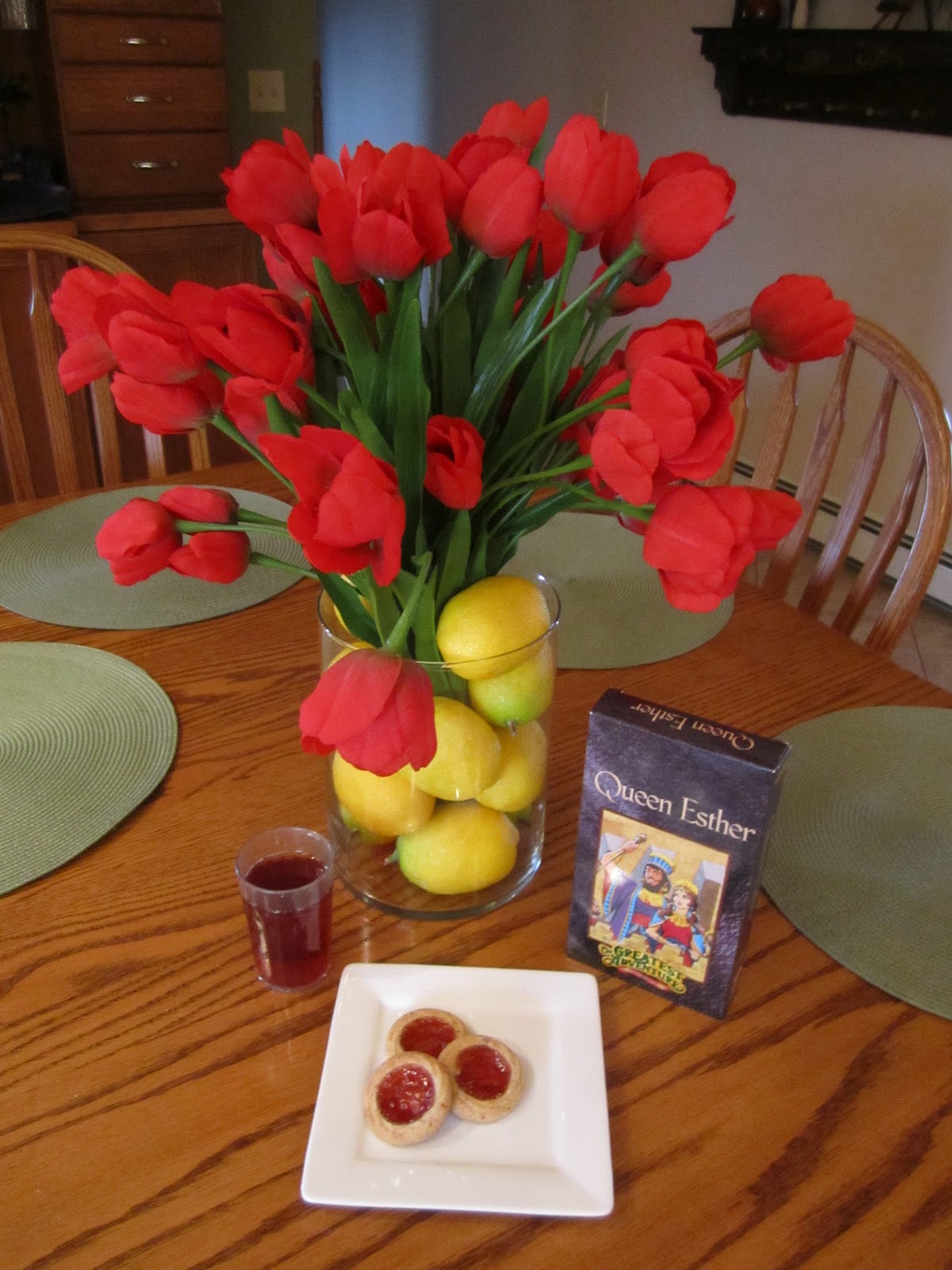
I  am having a sub next week while I go on a Culinary vacation to Napa, California.  I chose the video of Queen Esther for the sub to play for the class.
The story of Esther takes place during the reign of the King Ahasuerus of Persia.  Queen Vashti was disobedient to the King so he had her removed from the throne.  When the king was searching for her replacement he found a Hebrew girl named Esther who became the new Queen, the king did not know she was a Hebrew. 
Shortly afterwards Esther’s uncle Mordecai, discovered a plot by Haman to kill all of the Hebrews.  Mordecai asked Esther to appeal to the King to save the Hebrews.  Esther fasted and prayed before approaching the King.  Esther planned a banquet for the King and Haman; during the banquet Esther told the King of Hamans plan to kill the Hebrew people.  The king had Haman hanged for his plans.  The Jewish people have a Feast of Purim to celebrate how Esther saved their lives.
My treat for the students are Pepperidge Farms Verona cookies because they are a sweet rich cookie much like a cookie served at Purim.  I also have juice for them to drink.

Thursday, February 16, 2012

Lent

It's hard to believe that Lent begins next week. For the students treat this week they recieved 40 oyster crackers symbolizing 40 days of lent.  The oyster crackers are plain and flavorless, just as our lives should be during lent.  They also contain no sugar, dairy or eggs and in the old traditions all of those things needed to be eliminated from our diets during lent. 

Wednesday, February 8, 2012

Passover

Tonight we begin our unit on Moses.  Each year that teach about Moses I gain more respect for him.  He is becoming my favorite old Testament character.  Tonight we will start at the beginning of the story of Exodus, from the birth of Moses through the 10 plagues.  The final plague was the death of the first born son.  The Israelites were instructed to kill a lamb, pour the blood of the lamb on their doorpost so God would pass over their house and not kill the firstborn son.  The Israelites had to prepare their food in a hurry, so their bread did not have time to rise.  God later tells the Israelites to celebrate Passover each year to remind them of how he saved the Israelites from the Egyptians.  Fast forward to the New Testament and it was the night of Passover that Jesus, who is the perfect lamb who  shed his blood for us, instituted the Eucharist.
I made unleavened bread and served grape juice with it to my students.

Monday, February 6, 2012

Our Lady of Guadalupe


Last week I was on vacation to Cancun, Mexico, so I thought I would have my sub show the movie of Juan Diego and talk about the imagery of the Tilma. 
According to Catholic tradition, on December 9, 1531, Juan Diego had a vision of a young woman while he was on a hill in the Tepeyac desert, near Mexico City. The lady asked him to build a church exactly on the spot where they were standing. He told the local Bishop who asked for proof in exchange.
Juan Diego went back later and saw the lady again. He told her that the bishop wanted proof, and she instructed Juan Diego to go to the mountain top, where he found roses, which were native to the Bishop's hometown and could not possibly bloom during wintertime. Juan Diego cut the roses, placed them in his apron-like tilma and returned to the bishop; an imprint of the Blessed Virgin Mary appeared on the tilma from the residue of the soil and roses.
Today, the icon is displayed in the nearby Basilica of Guadalupe, now one of the most visited Catholic shrines in the world.  My mother in-law was lucky enough to see the Tilma when she was vacation in Mexico.  She said the pilgrims climbed the steps on their knees to show their respect for the Tilma. 
The students enjoyed served salsa and chips while they watched the movie.